


Last Updated: November 22, 2026
Quick Summary
Family weekend running challenges for beginners work best as low-pressure, non-competitive goals that fit around busy weekends, with walking and jogging both counting. Start with a run-walk plan, short running games for children, themed trail treasure hunts, simple tracking and a plan for the week-three motivation dip.
- The run-walk plan starts with jogging 1 minute and walking 2 minutes, repeated 5 times.
- Keep children’s running games to around 15 to 20 minutes and stop while everyone still enjoys it.
- Hide five to eight markers or clues for a themed trail treasure hunt on a safe local route.
- Increase weekly distance by no more than about 10% and keep at least one full rest day between sessions.
- Plan for the week-three dip by changing one thing and shortening the session rather than skipping it.
Table of Contents
- Why Weekend Running Challenges Work for Families
- Challenge 1: The Run-Walk Plan for Beginners
- Challenge 2: Running Games for Children
- Challenge 3: Themed Trail Treasure Hunts
- Challenge 4: Apps for Tracking Runs Together
- Challenge 5: How to Stay Motivated to Run as a Family
- Getting Started This Weekend
- Frequently Asked Questions
Why Weekend Running Challenges Work for Families
Family weekend running challenges give everyone a shared goal without the pressure of a race entry, a start line or a finishing time. A simple weekly target can turn a reluctant walk into a habit the whole household looks forward to.
- No race entry or travel to an event required
- Everyone moves at their own pace
- Short sessions fit around busy weekends
The low-pressure appeal of non-competitive goals
A running goal works best when it feels achievable. For beginners, that means ditching pace targets and focusing on consistency instead.
The NHS physical activity guidelines recommend that adults aim for at least 150 minutes of moderate activity each week, and children should be active every day.
Below, we break down five family weekend running challenges for beginners, with rules, tracking tips and recovery advice.
Challenge 1: The Run-Walk Plan for Beginners
The run-walk plan is the safest starting point for any family new to running.
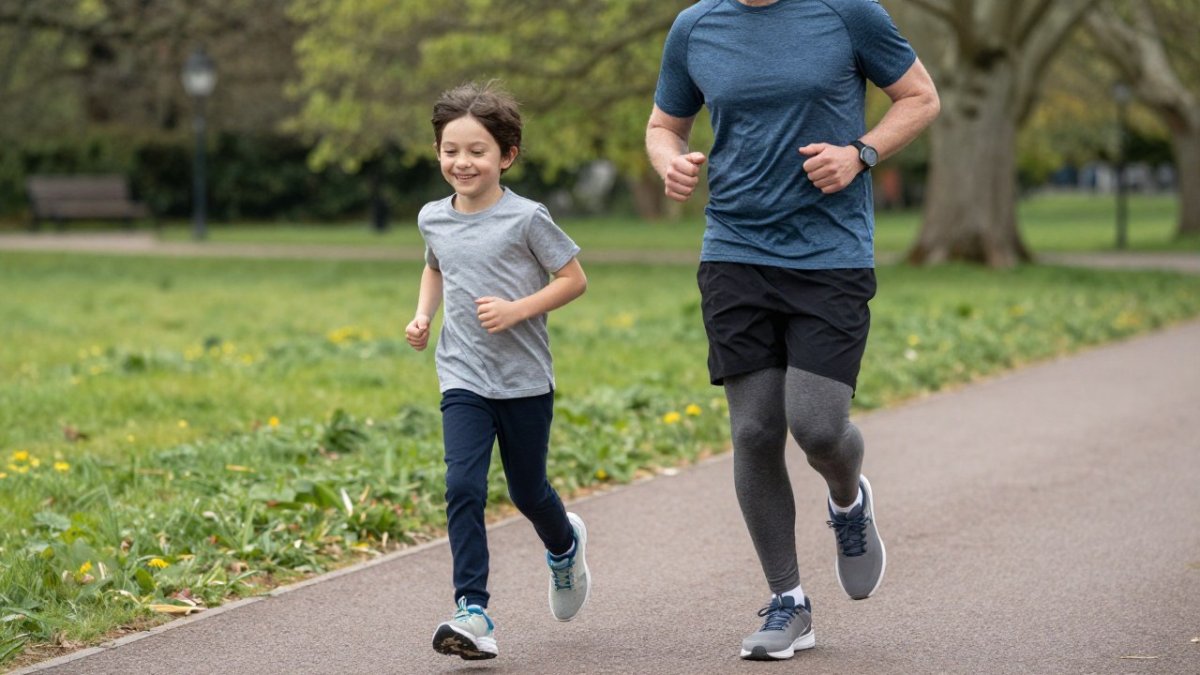
How it works:
- Week 1: jog 1 minute, walk 2 minutes, repeat 5 times
- Week 2: jog 2 minutes, walk 2 minutes, repeat 5 times
- Week 3: jog 3 minutes, walk 1 minute, repeat 5 times
Keep the whole session to around 20 to 25 minutes, with a short walk at the start and end to warm up and cool down.
Watch out: the most common mistake is skipping ahead too fast. If a child or adult cannot talk in short sentences while jogging, slow down or walk longer.
Once the family can complete a run-walk session comfortably, a beginner-friendly virtual challenge gives you a clear goal to work towards. You can explore beginner virtual running challenges that suit walkers and joggers alike.
Challenge 2: Running Games for Children
Running games keep children interested when a plain jog feels boring. The trick is to make movement the fun part, not the finish line.
Five games to try:
- Traffic lights: red means stop, amber means walk, green means run
- Follow the leader: take turns setting the pace and route
- Treasure run: hide small markers along a path to collect
Keep sessions short, around 15 to 20 minutes, and stop while everyone is still enjoying it.
If your child is losing interest, these ways to keep kids motivated during runs give you more ideas. And if you are wondering whether your child is ready for a longer distance, this guide on whether children can take part in a 5K run explains how to judge readiness and build up safely.
Challenge 3: Themed Trail Treasure Hunts
A themed trail treasure hunt turns a local walk or jog into an adventure.
How to set one up:
- Choose a safe local route, such as a park, towpath or woodland trail
- Hide five to eight simple markers or clues before you set off
- Give each person a checklist to tick off
- Walk or jog between clues, with walking breaks as needed
- Finish with a small reward at home, like a family film night
Trail routes add variety and gentle hill work without feeling like training. Keep to marked paths, check daylight hours, and in winter wear something visible and take a phone.
Themed events work the same way. A seasonal or novelty theme gives the challenge a story, and children remember the story long after they forget the distance.
Challenge 4: Apps for Tracking Runs Together
Tracking turns a family challenge from a vague intention into something you can see add up.
What to track each week:
| What to track | Why it helps | How often |
|---|---|---|
| Total distance (km, with miles if you prefer) | Shows progress across the month | After each session |
| Sessions completed | Builds consistency | Weekly |
| Longest walk or jog | Tracks endurance gains | Weekly |
| How everyone felt (1-5) | Spots tiredness and overload early | After each session |
| Rest days taken | Confirms recovery is happening | Weekly |
Three ways to track, from simplest to most detailed:
- Paper or a shared note. A wall chart or shared phone note with columns for date, distance, time and how everyone felt. Free, works for any age, and children can tick their own box.
- A free fitness app with a group or club feature. Most mainstream free apps let you create a group, log walks and jogs, and see a weekly total. Useful if family members already carry a phone; less suitable for younger children without devices.
- A GPS watch paired with an app. More accurate for distance and pace, and useful if a parent wants to track effort rather than just time. Not necessary for beginners, a phone in a pocket or armband is plenty.
If you are weighing up a watch against a phone, this comparison of a running watch vs phone for tracking covers GPS accuracy, battery life and the metrics that actually matter for family sessions.
Set clear completion criteria before you start. A challenge without an end point drifts. Keeping the goal focused on showing up makes it easier to build a routine that lasts, and Start4rmStart can help you think about how to carry that consistency beyond the challenge.
Scale it to each person. The same challenge can look different for a five-year-old, a returning runner and a grandparent:
- Beginner or young child: count minutes moving rather than distance, and let walking count fully.
- Returning runner: log distance but cap weekly increases at roughly 10% to reduce injury risk.
- More experienced family member: add a gentle hill or a slightly longer weekend session, but keep the shared goal the same so nobody is left behind.
Cost and accessibility. Everything above can be done for nothing beyond a phone you already own, and a paper chart works for children without devices.
Watch out: do not let tracking turn into comparing. One child’s distance is not a score against another’s, and a parent’s pace is not a target for a beginner.
Challenge 5: How to Stay Motivated to Run as a Family
Motivation fades around week three for most beginners, and that dip is predictable. Planning for it in advance is what separates a challenge that finishes from one that fizzles out after two weekends.
Five ways to keep it going:
- Set a small reward for completing the month, not for speed or distance
- Let each family member choose one route or game
- Keep one session short and easy every week
Plan for the week-three dip. By the third weekend, novelty has worn off and the finish still feels distant. Two simple fixes: change one thing (a new route, a new game, a different time of day) and shorten the session rather than skip it. A ten-minute walk-jog keeps the habit alive; a missed weekend often becomes two.
Manage the load, not just the mood. Streaks and ambitious distance goals quietly increase training load, and that is where beginner injuries start. A few sensible rules:
- Increase weekly distance by no more than about 10% from one week to the next.
- Keep at least one full rest day between running sessions.
- Alternate harder weekends with easier ones, a longer family walk counts as an easy weekend.
Recovery matters as much as the sessions. Sore legs, poor sleep and grumpiness are signs to ease off.
Make it self-directed so it survives real life. Organised events depend on a date, a venue and travel; a family challenge should not.
Keep it accessible and low-cost. You do not need new kit, a gym membership or an entry fee.
For more ideas on keeping the habit alive, this guide on how to stay motivated to run covers goal-setting, habit-building and long-run tricks.
Getting Started This Weekend
You do not need new kit or a training plan to start. Pick one challenge, set a 20-minute session and go.
Your first-week checklist:
- Choose one challenge from the five above
- Pick two days that suit the whole family
- Plan a safe, local route
- Agree a small reward for the end of the month
Keep the first week gentle. Walk more than you think you need to, and finish feeling like you could do a little more.
Starting a family challenge is the easy part. Keeping everyone motivated for a month takes a goal worth working towards, and that is where we can help.
Frequently Asked Questions
How can a beginner start running with their family?
Start with a run-walk plan for beginners: alternate one minute of gentle jogging with two minutes of walking, three times a week for 20 minutes. Choose a flat, traffic-free route such as a local park. Keep the pace conversational so everyone can chat. Children can cycle or scoot alongside if they prefer. Set a family goal, like completing 10 minutes of continuous jogging by the end of the month, and celebrate small wins together.
What are some fun running challenges for families?
Try a themed trail treasure hunt where you collect natural items or spot landmarks along a route. Running games for children, such as follow-the-leader or interval tag, add playful bursts of speed. A run-walk plan for beginners builds fitness gradually. Apps for tracking runs let everyone log their distance and see progress. You could also set a family streak challenge, aiming to run or walk on every weekend for a month.
How far should a beginner run at the weekend?
Most beginners should start with a total distance of 1 to 2 miles (1.6 to 3.2 km) using a run-walk approach, where walking breaks are built in. Increase weekly distance by no more than 10 percent. For families with young children, 20 to 30 minutes of mixed walking and jogging is plenty. Focus on time on feet rather than pace, and always finish feeling you could do a little more.
Can children take part in a virtual running challenge?
Yes, many virtual running challenges allow walking, jogging or running at your own pace, so children can join in. Check the event rules for minimum age requirements and whether activity must be completed in one session. Family-friendly challenges often let you split distance across several days. Use apps for tracking runs to log each family member’s effort, and choose a challenge with a completion deadline that fits your weekend schedule.
