

Table of Contents
- Why Flat Feet Change What You Need From a Running Shoe
- How to Tell If You Have Flat Feet
- Stability Running Shoes for Flat Feet: What They Do
- Neutral Running Shoes for Flat Feet: When They Work
- Orthotics for Flat Feet Running: Insoles, Custom and Off-the-Shelf
- A Fit Checklist for Buying Running Shoes for Flat Feet
- Common Mistakes to Avoid When Choosing Running Shoes for Flat Feet
- Conclusion
- Frequently Asked Questions
Last Updated: 17 October 2026
Why Flat Feet Change What You Need From a Running Shoe
Flat feet change how your foot rolls when it lands, and that changes which running shoes work for you. At The Running Bug, we see plenty of runners who buy a shoe for its colour or its reviews, then wonder why their knees ache after every 5k. The shoe has to match the foot.
Here is the key point. A flat foot tends to roll inward more than a neutral foot. That inward roll is called overpronation. It is not a flaw, and it is not a diagnosis. It is simply a movement pattern.
A shoe built for a flat foot helps control that roll. A shoe built for a neutral foot lets it happen. Pick the wrong one and you feel it in your shins, your knees, or your arches.
This guide shows you exactly how to choose running shoes for flat feet. We cover how to check your own feet, what stability shoes actually do, when neutral shoes still work, and the mistakes that cost runners the most.
How to Tell If You Have Flat Feet
You can check for flat feet at home in under a minute. Wet the sole of your foot and stand on a piece of cardboard or dark paper. Then look at the print.
- Full footprint: the whole sole shows, with little or no inward curve. This points to a flat foot.
- Half footprint: you see the heel, the ball, and a band down the outside. This is a normal arch.
- Thin strip: only the heel and ball show, joined by a narrow line. This suggests a high arch.
Do the test on both feet. Plenty of runners are flat on one side and neutral on the other.
You can also look at your shoes. Wear patterns on the inner edge of the sole suggest your foot rolls inward. A quick check of NHS guidance on foot shape and arch types can help you read what you find.
One warning: a flat foot that causes no pain needs no treatment. If you feel sharp pain, numbness, or swelling, see a GP or a qualified podiatrist before you change your shoes.
Stability Running Shoes for Flat Feet: What They Do
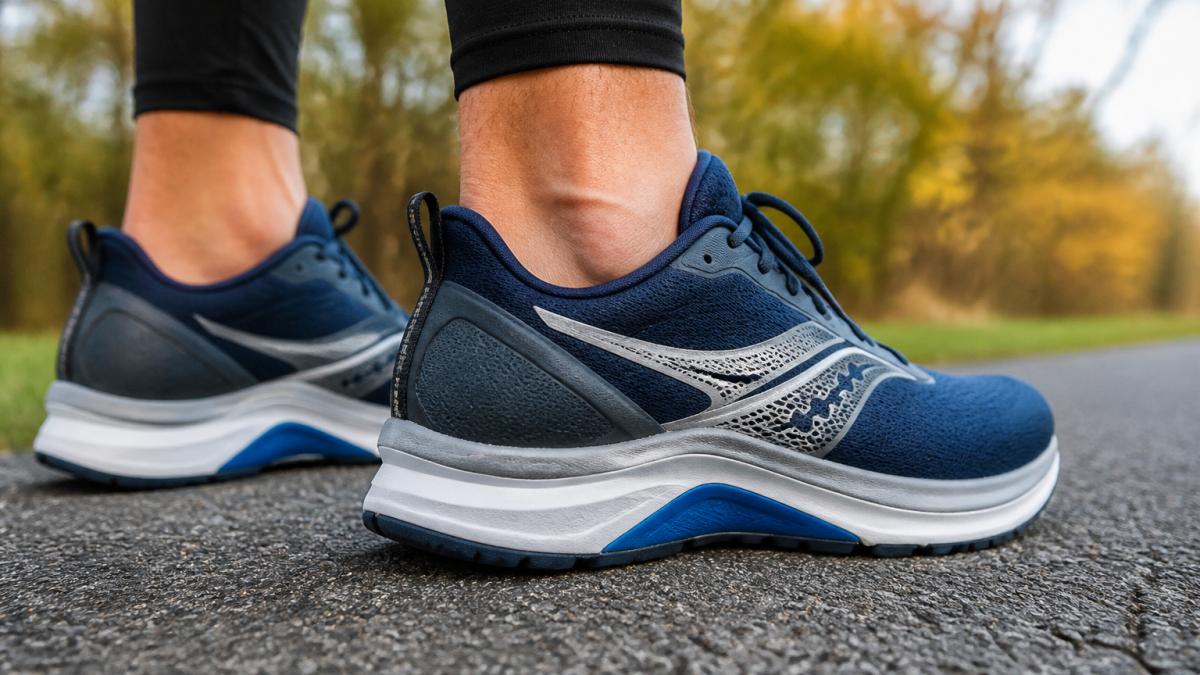
Stability running shoes support the inside of the foot to limit inward roll. They use a firmer section of foam under the arch, and sometimes a plastic or composite shank, to resist the foot collapsing inward. The rest of the shoe stays soft so the ride still feels smooth.
Two features matter most:
- A firmer medial post: the denser foam on the inner side of the midsole. It slows the inward roll.
- A wider, more supportive base: a broader platform gives the foot more to land on.
Stability shoes for flat feet suit runners who overpronate mildly to moderately. They are the most common choice for flat-footed runners, and the category has come a long way from the heavy, stiff shoes of twenty years ago.
Motion control shoes sit at the firmer end of the same idea. They add more support and a straighter shape for feet that roll inward heavily. They can feel clunky on longer runs, so we would only reach for them if a podiatrist suggests it.
Neutral Running Shoes for Flat Feet: When They Work
Neutral running shoes for flat feet can work well, and many runners assume they cannot. The shoe has no medial post. It lets the foot move naturally.
So when does a neutral shoe suit a flat foot?
- Your flat foot is flexible and causes no pain.
- You run shorter distances, such as 5k to 10k.
- You have strong feet and calves and no history of shin or knee trouble.
- A podiatrist has told you that you do not need extra support.
The catch is cushioning. A soft, neutral shoe can let a flat foot roll further inward. If you try one, watch for sore arches or inner-knee niggles in the first few weeks. If they appear, move to a stability shoe.
Our honest view: if you are new to running and flat-footed, start with a mild stability shoe. You can always move to neutral later once you know how your feet behave.
Orthotics for Flat Feet Running: Insoles, Custom and Off-the-Shelf
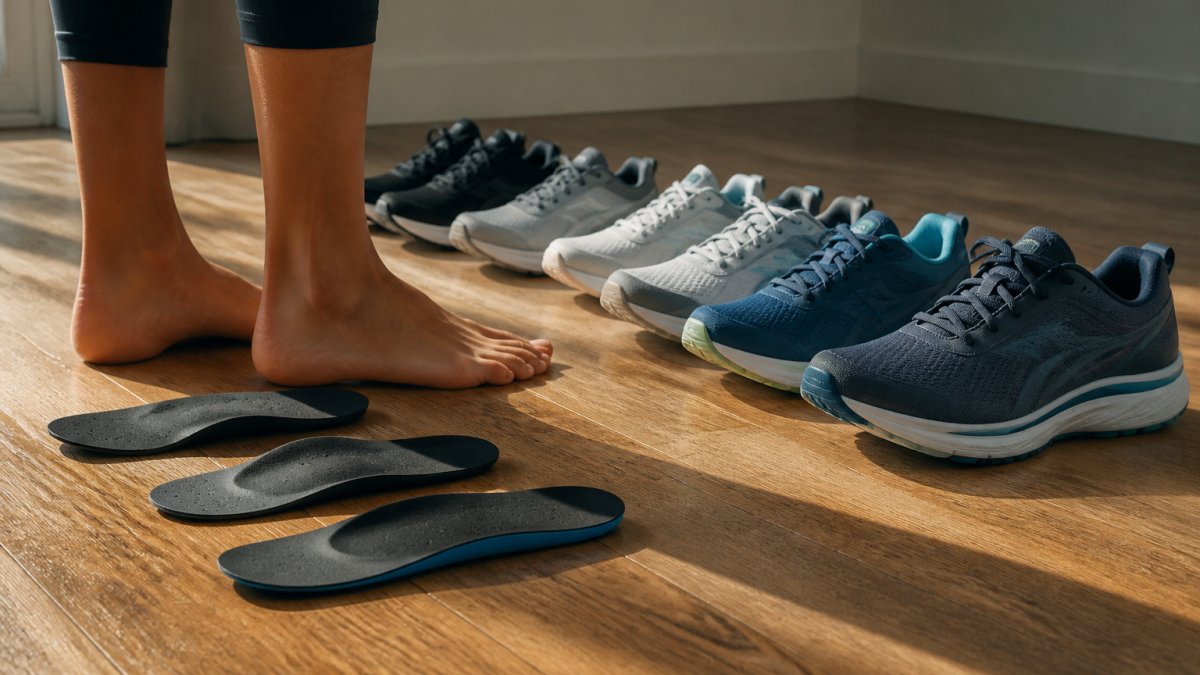
Orthotics for flat feet running range from cheap off-the-shelf insoles to custom devices made by a podiatrist. They change how the foot sits inside the shoe, and they can reduce the inward roll that causes discomfort.
Here is the practical split:
- Off-the-shelf insoles: sold in most running shops for a modest sum. They add arch support and cost far less than custom work. Good first step.
- Custom orthotics: made from a cast or scan of your foot by a podiatrist. They cost more and take time, but they fit your foot exactly.
A few rules we would give any runner:
- Take your old insoles out before you add new ones. Two insoles make the shoe too tight.
- Give any new insole a week or two of short runs before a long one.
- If you use custom orthotics, take them with you when you try shoes on.
The Royal College of Podiatry can help you find a registered podiatrist if you want a proper assessment.
A Fit Checklist for Buying Running Shoes for Flat Feet
Use this checklist every time you try a pair. It takes ten minutes and saves weeks of soreness.
- Try shoes late in the day. Feet swell during the day, so an evening fitting is more accurate.
- Wear your running socks. The sock changes the fit more than you would think.
- Leave a thumb’s width at the toe. Your longest toe should not touch the end.
- Check the heel hold. Your heel should stay locked in place as you walk and jog.
- Feel the arch. The shoe should support the arch without pressing hard into it.
- Jog on a hard surface. Most shops let you run on a treadmill or outside. Use it.
- Test the flex point. The shoe should bend where your foot bends, at the ball, not the middle.
- Bring your old shoes. The wear pattern tells the staff how your foot moves.
- Ask about the returns policy. Confirm you can run in them indoors and still return them.
- Check the width. Flat feet are often wider. Ask for a wide fit if the standard one pinches.
| Check | What Good Looks Like | Why It Matters |
|---|---|---|
| Toe space | Thumb’s width clear | Stops black toenails |
| Heel hold | No slip when jogging | Prevents blisters |
| Arch feel | Support, no pressure | Reduces arch ache |
| Flex point | Bends at the ball | Smooths your stride |
| Width | No pinch at the sides | Comfort on long runs |
Common Mistakes to Avoid When Choosing Running Shoes for Flat Feet
The biggest mistake is buying for looks or hype. A shoe that wins awards can still be wrong for your foot. Here are the traps we see most often.
Buying online without trying the fit. Sizing varies between brands. A size 6 in one model can feel like a 5 in another. If you must buy online, check the returns policy first.
Assuming you need motion control. Most flat-footed runners do fine in a mild stability shoe. Motion control is for heavy overpronation, and it can feel stiff if you do not need it.
Ignoring pain because the shoe was expensive. A shoe that hurts is the wrong shoe, whatever it cost. Take it back while you still can.
Changing too much at once. Do not switch shoes, add insoles, and increase your distance in the same week. Change one thing, then judge.
Do not run through sharp arch or heel pain to “break in” a new shoe. Shoes do not need breaking in. Pain in the first week usually means the fit or the support level is wrong.
Conclusion
Choosing the right shoe for a flat foot comes down to three things: know your foot, match the support to how you roll, and test the fit properly. Get those right and the miles feel easier.
If you want a goal to aim at while you settle into your new shoes, The Running Bug runs flexible virtual challenges from 5k to marathon distance. You pick the time and place, submit your result, and earn a medal for your effort. New members get 15% off their first race, and every entry supports a charity.
Get started with The Running Bug and give your training a target worth chasing.
Frequently Asked Questions
How do I choose running shoes if I have flat feet?
Start by working out how your foot moves when you run. Flat feet often roll inwards (overpronate), which is why stability running shoes for flat feet are a common starting point. Get your gait checked at a running shop or record yourself running on a treadmill. Then prioritise fit: a thumb’s width at the toe, a snug heel and no pressure across the arch. Try shoes on late in the day when feet are at their largest, and test them on a hard surface before buying.
Are stability running shoes better for flat feet?
Not automatically. Stability running shoes for flat feet add support on the inner edge of the midsole, which helps if your foot rolls inwards noticeably. If you have flat feet but a neutral gait, a stability shoe can feel intrusive and even push you the other way. Use a gait check to see whether you overpronate. Many runners with flat feet do well in stability shoes, but some prefer neutral running shoes for flat feet paired with supportive insoles.
Should I choose neutral or stability running shoes for flat feet?
Choose based on how your foot behaves, not the shape of your arch alone. If your ankle rolls inwards and your knees track inwards, stability shoes are worth trying. If your foot lands and moves through cleanly, neutral running shoes for flat feet may suit you better, especially with a supportive insole. Test both on a treadmill if you can. Comfort and fit should decide it, and a shoe that feels wrong in the shop rarely improves on the run.
Can I run with flat feet without orthotics?
Many runners with flat feet run without orthotics, especially if their shoes fit well and their mileage builds gradually. Orthotics for flat feet running are worth exploring if you get arch, heel or knee discomfort that doesn’t settle. Off-the-shelf insoles are a low-cost first step; custom orthotics from a podiatrist cost more and suit persistent problems. If pain continues despite good shoes and sensible training, book a podiatrist rather than buying more shoes.