

Table of Contents
- How Long Do Running Shoes Last? The Mileage Truth
- Why 500 Kilometres Is the Common Benchmark
- How Your Weight and Running Style Change the Timeline
- Running Shoe Mileage Limit: What the Numbers Really Mean
- Signs of Worn Out Running Shoes You Should Never Ignore
- How to Extend the Life of Running Trainers
- Time vs Mileage: Which Replacement Rule Wins?
- What Happens If You Keep Running in Dead Shoes
- Frequently Asked Questions
Last Updated: September 26, 2026
How Long Do Running Shoes Last? The Mileage Truth
Most running shoes last between 400 and 500 miles, which is roughly 640 to 800 kilometres. After that, the cushioning breaks down and your risk of injury climbs.
That is the short answer. The longer answer depends on your weight, your stride, and where you run.
People want to know when to replace their trainers without guessing. So here is the honest breakdown.
The 500-kilometre mark has become the industry’s default advice. But it is a rough guide, not a rule. Some runners get 300 kilometres from a pair. Others stretch to 800. The difference comes down to how you run and what you weigh.
Below, we will show you exactly how to read the signs, track your mileage, and know when it is genuinely time to buy new shoes.
Why 500 Kilometres Is the Common Benchmark
The 500-kilometre figure comes from how shoe midsoles work. The foam in a running shoe compresses with every stride. Over time, it loses its ability to spring back.
A typical runner takes around 1,500 steps per mile. Each step puts force through the midsole. The foam absorbs that force, then returns energy to your next step.
After roughly 500 kilometres, most foams lose a noticeable amount of their bounce. You might not feel it yet. But your joints will.
According to research on running shoe degradation from sports science journals, midsole cushioning declines gradually before you notice any change.
The problem is that the shoe still looks fine on the outside. The upper holds together. The tread has life left. But the midsole is dead.
How Your Weight and Running Style Change the Timeline
Heavier runners wear through shoes faster. A 90-kilogram runner puts more force through each step than a 60-kilogram runner. That extra load compresses the foam quicker.
Your stride matters too. Runners who land hard on their heels tend to break down heel cushioning first. Forefoot strikers wear the front of the shoe faster.
Here is a rough guide based on body weight:
| Runner Weight | Expected Shoe Life |
|---|---|
| Under 60kg | 700-800 km |
| 60-75kg | 550-700 km |
| 75-90kg | 450-550 km |
| Over 90kg | 350-450 km |
Running style also plays a role. A smooth, efficient stride puts less stress on the shoe. A heavy, pounding gait wears it out faster.
Weigh yourself in your running kit, then add the weight of a full water bottle. That is your true running weight. Use it when checking the table above.
Running Shoe Mileage Limit: What the Numbers Really Mean
The mileage limit is not a hard stop. It is the point where cushioning drops below the level that protects your joints.
Think of it like tyre tread. You can keep driving on worn tyres. But your grip gets worse, and your risk goes up.
Most shoe companies design their midsoles to last around 500 kilometres. Some premium foams last longer. Cheaper foams break down sooner.
The key is tracking your actual distance. If you run 30 kilometres a week, you will hit 500 kilometres in about four months. If you run 15 kilometres a week, that same shoe lasts eight months.
Surface, Pace and Terrain: The Hidden Multipliers
Where you run changes everything. Tarmac is abrasive. It grinds down the outsole and stresses the midsole with every hard landing.
Trail running adds different wear. Rocks and roots cut into the tread. Uneven ground twists the shoe in ways it was not designed for.
Treadmill running is gentler. The belt gives slightly, so there is less impact. But the repetitive motion can wear one area faster.
Pace matters too. Faster running means shorter ground contact time. That actually reduces wear per kilometre. Slow, heavy plodding puts more stress on the foam.
Signs of Worn Out Running Shoes You Should Never Ignore
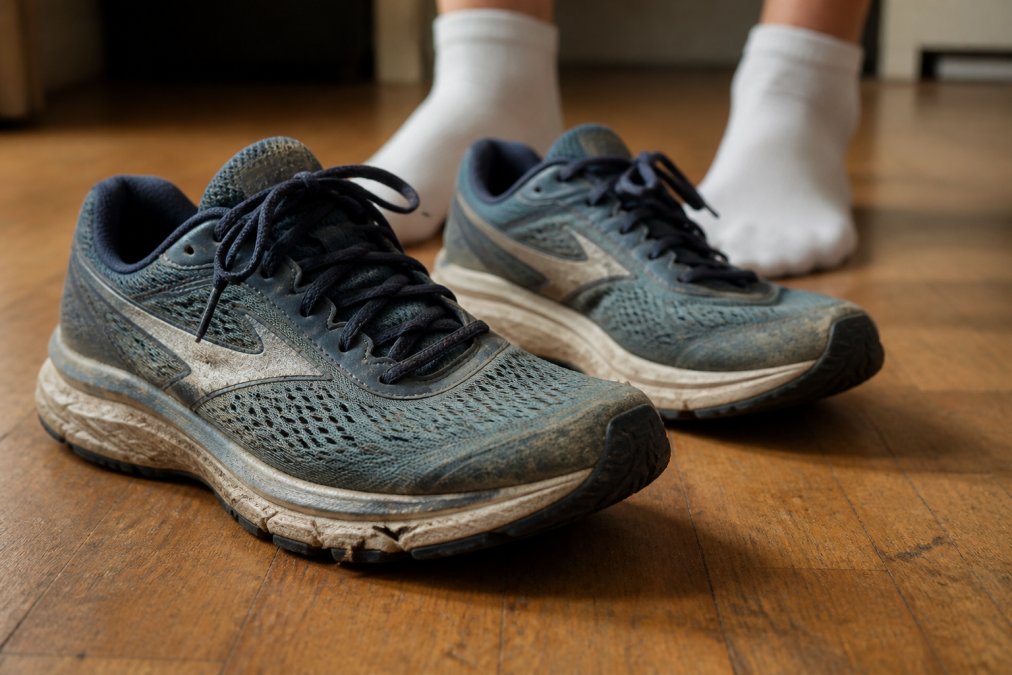
Your shoes are telling you they are done. You just need to know what to look for.
Check these signs every few weeks:
- Visible creasing in the midsole. Deep compression lines mean the foam is collapsing.
- Worn tread patches. If the outsole is smooth in spots, grip is gone.
- A twisted shoe. Hold the shoe by the heel and toe. If it folds in half easily, the support is gone.
- New aches and pains. Sore knees, shins, or hips after runs that used to feel fine.
- A flattened insole. If the insole looks compressed, the midsole is likely worse.
The Midsole Test: When Cushioning Quietly Dies
Press your thumb into the midsole foam. Do this on a new shoe first, so you know how it should feel.
On a fresh shoe, the foam springs back quickly. On a dead shoe, your thumb leaves a dent that stays.
You can also compare both shoes. If one feels noticeably firmer than the other, the softer one has broken down.
Running in dead shoes is a common cause of overuse injuries. Shin splints, plantar fasciitis, and knee pain often trace back to worn cushioning. Replace your shoes before the pain starts, not after.
How to Extend the Life of Running Trainers
You can get more kilometres from every pair. These habits make a real difference:
- Rotate two pairs. Alternating shoes gives the foam time to recover between runs.
- Untie before removing. Pulling shoes off by the heel breaks down the structure.
- Air them out. Damp shoes break down faster. Let them dry away from direct heat.
- Keep them for running only. Walking around town adds pointless mileage.
- Avoid the washing machine. Heat and agitation damage the foam and glue.
- Track your kilometres. Use a running app or a simple notebook.
A common mistake is wearing your running shoes for everyday errands. Those steps count. By the time you run in them, they have already done hundreds of kilometres.
Time vs Mileage: Which Replacement Rule Wins?
Mileage wins for regular runners. Time wins for occasional runners.
If you run three or more times a week, track your distance. Replace your shoes when you hit the range for your weight.
If you run once a week or less, time matters more. Foam degrades even when you are not using it. After 12 to 18 months, most foams lose their bounce.
The table below shows which rule to follow:
| Your Running Habit | Replacement Rule |
|---|---|
| 3+ runs per week | Replace at your mileage limit |
| 1-2 runs per week | Replace every 12 months |
| Occasional runner | Replace every 18 months |
| Stored unused for 2+ years | Replace before use |
What Happens If You Keep Running in Dead Shoes
Your shoes stop protecting you. That is the simple truth.
The midsole absorbs impact so your joints do not have to. When the foam dies, that force travels up through your feet, ankles, and knees.
Many runners find that nagging injuries clear up after a shoe change. The shoes were the problem all along.
There is also a performance cost. Dead foam returns less energy. Your runs feel harder than they should.
If you are training for a virtual challenge, do not let worn shoes derail your progress. Check your mileage before your next big push.
Frequently Asked Questions
How many miles should running shoes last?
Most running shoes last between 300 and 500 miles (roughly 480 to 800 kilometres), though many manufacturers suggest replacing them around the 500-kilometre mark. Your weight, running style, and the surfaces you run on all affect this. Heavier runners or those who run on rough trails may need to replace shoes sooner, while lighter runners on smooth tarmac might get a bit more mileage. Tracking your runs in a diary or app helps you know when you are approaching the limit.
What are the signs that running shoes need replacing?
Key signs of worn out running shoes include flattened or compressed midsoles that no longer spring back, visible creasing along the side of the sole, worn-out tread on the outsole, and a loss of grip on wet surfaces. You might also notice new aches in your knees, hips, or shins after runs that used to feel comfortable. If the shoe feels noticeably less cushioned or your foot slides around inside, it is time to replace them.
Does running on old shoes cause injury?
Running in worn-out shoes can increase your risk of injury because the midsole loses its ability to absorb impact. This can place extra stress on your joints, muscles, and tendons, potentially leading to conditions like plantar fasciitis, shin splints, or knee pain. While not everyone will get injured, the cushioning and support you rely on degrade over time. Replacing your shoes at the right time is a simple way to protect your body and keep running comfortably.
Do running shoes expire if not used?
Yes, running shoes can degrade even if you do not run in them. The foam and adhesives in the midsole break down over time, especially if stored in hot or damp conditions. A general rule is to replace unused shoes after five to seven years, as the cushioning may have hardened or crumbled. If you are unsure, press your thumb into the midsole; if it feels firm and does not bounce back, the shoe has likely expired.
Your shoes have a shelf life, and ignoring it costs you comfort and progress. At The Running Bug, we help runners stay motivated with flexible virtual challenges from 5k to marathon distance, stylish medals for every finish, and support for charitable causes. Create an account to claim 15% off your first race, submit your evidence, and earn your medal. Get started with The Running Bug and keep every step rewarding.