


Quick Summary
Yes, most children can take part in a 5K, provided they enjoy running, feel no pain and are growing normally. Check the event’s minimum age and entry terms first, as organisers set their own rules for children 5K entries. Build up gradually over several weeks before race day.
- Check the minimum age and whether under-18s need a parent or guardian to sign a waiver.
- Judge readiness by enjoyment, comfort running 15 to 20 minutes, recovery and your child’s own interest.
- Follow a kids 5K training plan that builds over about eight weeks, with three sessions a week.
- Keep training sessions short and make running a game to maintain your child’s motivation.
- Start slowly on race day, stay with younger children and agree a walk-back plan in advance.
Table of Contents
- Can Children Take Part in a 5K Run at All?
- Step 1: Check the Minimum Age for a 5K Run
- Step 2: Judge Whether Your Child Is Ready
- Step 3: Build a Kids 5K Training Plan
- Step 4: Learn How to Train a Child for a 5K
- Step 5: Keep Children Running 5K Safely on the Day
- Booking Your Child’s First 5K Event
- Frequently Asked Questions
Can children take part in a 5K run? In most cases, yes. Whether your child is ready depends on their age, fitness, interest in running and the event itself, and many families find that a planned approach to children 5K entries makes the decision much clearer. There is no single universal minimum age for a 5K, so the right answer comes from looking at the individual child and the race rules. This guide walks you through the questions to ask, how to prepare, and how to keep the day safe.
Nationwide Children’s Hospital guidance on children running distance events says that children who enjoy running and have no pain need not be kept from training for or taking part in distance events. That is a useful starting point, but it is guidance, not a rule for every race. Read the specific event details before you register, especially the rules for children 5K entries, as these vary widely between races.
Can Children Take Part in a 5K Run at All?
Children can take part in a 5K, and many do. Some events include youth races alongside the adult 5K, and some have no minimum age. If you want a child-friendly option, virtual running challenges for kids let them build distance at home with goals and medals. Others set a limit or require an adult to run with a younger child.
Many sources tend to agree on one point. A child who enjoys running, feels no pain and is growing normally can usually build up to 5K distance safely. PubMed review on children and adolescents running marathons also argues that a child’s social, academic and psychological needs matter as much as physical ability when deciding whether to take part.
Where guidance differs, the event and the child decide. Not every child is ready at the same age.
Step 1: Check the Minimum Age for a 5K Run
Always check the entry rules before you do anything else. Event organisers set their own policies.
- Look for a minimum age on the event page. Many races state one clearly in the entry terms.
- Check whether under-18s need a parent or guardian to sign a waiver. This is common for children’s entries.
- Ask whether a youth or kids’ race exists. Some events run a shorter distance for younger children on the same day.
- Contact the organiser if the rules are unclear. A short email can save a wasted entry fee.
If the event has no age limit, that does not mean every child is ready. It only means the organiser allows entry.
Step 2: Judge Whether Your Child Is Ready
Readiness matters more than age. Ask these questions before you commit:
- Does your child enjoy running, or do they only run because you asked?
- Can they run or jog for 15 to 20 minutes without stopping, or walk-run comfortably?
- Do they recover well, without pain or unusual tiredness?
- Are they keen to take part, not just going along with it?
A quick check you can do at home:
- Your child runs for 20 minutes with short walking breaks
- They talk comfortably while running
- They want to try a 5K
- They have no pain or injury that worries you
If you answer no to several of these, start with shorter distances or a fun run first.
Step 3: Build a Kids 5K Training Plan
A kids 5K training plan should build slowly over several weeks. Avoid jumping straight to the full distance.
A simple approach:
| Week | Sessions per week | Plan |
|---|---|---|
| 1-2 | 3 | Alternate 2 minutes jogging with 1 minute walking, 15 minutes total |
| 3-4 | 3 | Jog 5 minutes, walk 1 minute, repeat for 20 minutes |
| 5-6 | 3 | Run 10 minutes continuously, then build to 20 minutes |
| 7-8 | 3 | Run 20-25 minutes, add one longer session at the weekend |
Keep at least one rest day between sessions. Stop if your child reports pain, not just tiredness.
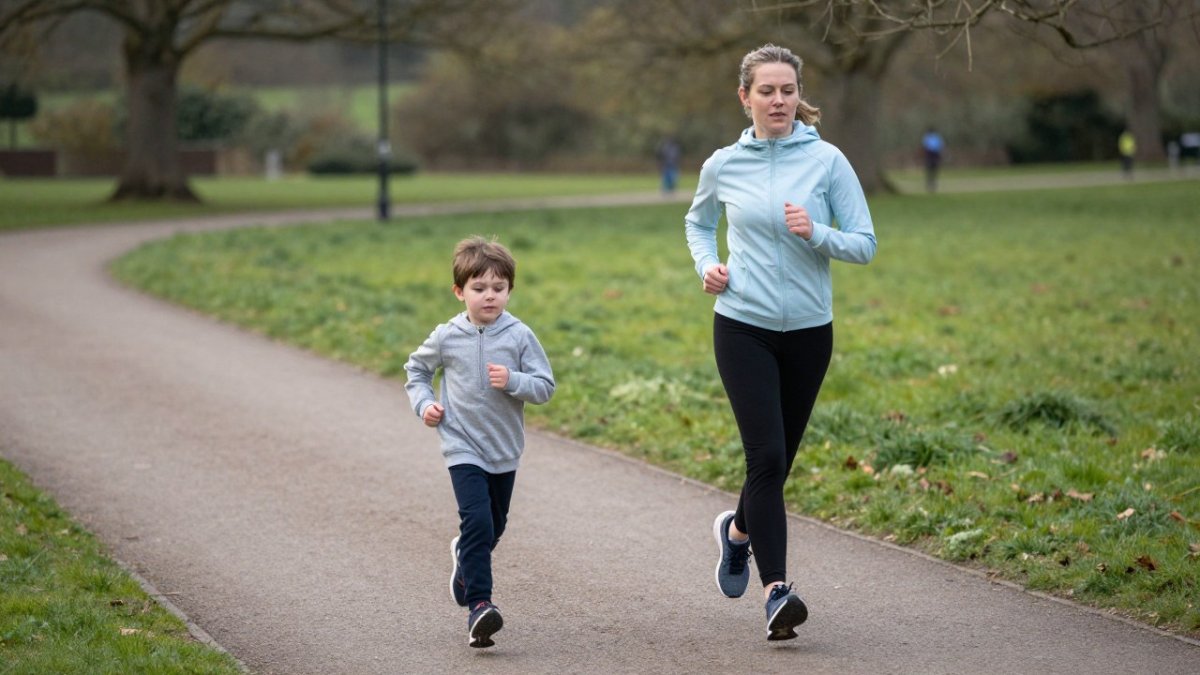
!A parent and a young child jogging together along a quiet park path in the early morning, both in trainers and light running clothes. The man is British.
Step 4: Learn How to Train a Child for a 5K
Training a child is different from training an adult. Motivation matters more than pace, and a good session is one they finish happily.
- Keep sessions short. Children tire quickly and lose interest in long runs.
- Make running a game. Try a route with a target, a count of trees, or a favourite park landmark.
- Let them set a goal. Ask them what they want to achieve, such as running the whole way without stopping.
- Run with them. Joining in keeps the session fun and lets you watch for signs of strain.
- Praise effort, not just speed. This keeps them coming back.
A common mistake is pushing for faster times too early. Focus on finishing comfortably first.
Step 5: Keep Children Running 5K Safely on the Day
Race day needs as much planning as training. The following points cover the practicalities that matter most for a child running a 5K.
- Hydration: Give small sips of water before the start rather than a large drink in one go. Check the event information for water stations on the course and carry a small bottle if your child is used to drinking while moving. On warm days, plan for more frequent stops.
- Weather: Dress for the temperature and keep layers light and easy to remove. In cold or wet conditions, a light showerproof layer and a hat are more useful than thick clothing. On warm days, choose light colours and a cap, and avoid running in the middle of the day.
- Pacing: Start slowly. Children often sprint at the beginning and fade badly. Agree a simple plan before the start, such as running the first kilometre at a comfortable talking pace.
- Supervision: Stay with younger children, or make sure a named adult is responsible for them throughout. Confirm the meeting point if you are separated, and make sure your child knows what to do if they lose sight of you.
- Cut-off times: Many events set a time limit for the course. Check this in advance and confirm whether walking is allowed, because a child who alternates running and walking may need longer than the published pace suggests.
- Facilities and safeguarding: Look for events that publish their safeguarding arrangements, such as whether under-18s must be accompanied, whether there are separate start areas for younger runners and whether toilets and first-aid points are marked on the course map.
- Finishing: If your child cannot finish, stopping is fine. Celebrate the effort and agree on a walk-back plan with them before the race so they know it is an option.
Watch out: a child who looks fine at the start can overheat quickly on a warm, sunny course, so keep an eye on colour, energy and how often they need to stop. If they become pale, dizzy or unusually quiet, stop and seek first aid rather than pushing on.
A useful habit is to walk the finish area before the race starts. Knowing where the exit is, where to meet and where the first-aid point sits removes a lot of stress if your child finishes tired or upset.
Booking Your Child’s First 5K Event
When you are ready to book, choose an event that suits the child’s ability and the family’s schedule. Before you enter, work through the following checks, which most event pages cover but rarely in one place.
- Minimum age and entry terms: Confirm the minimum age for the 5K and whether under-18s need a parent or guardian to sign a waiver. If the rules are unclear, contact the organiser before paying.
- Course conditions: Look at the route map for hills, uneven ground, road crossings and narrow sections. A flat, traffic-free park course is usually easier for a first 5K than a multi-terrain route.
- Cut-off times and walking policy: Check the time limit and whether walking is permitted. A child who run-walks may need more time than the published pace suggests.
- Facilities: Check for toilets, water stations and first-aid points on the course map, and confirm where the start and finish areas are.
- Safeguarding arrangements: Look for information on whether younger runners must be accompanied, whether there are separate youth starts and how the event manages children at the finish.
- Atmosphere: A charity fun run or a family-focused event is often a better first experience than a competitive race with a mass start.
If you are weighing options for a first 5K, it can help to compare alternatives to traditional charity events and see which fits your child best. A virtual running challenge for kids lets you do the distance at home at their own pace, which can be a useful stepping stone before a live race. You can also browse 5K races to find one that suits your child’s level, and the kids 5K virtual medal options are a fun reward for finishing, whatever the result.
Whichever route you choose, keep the focus on enjoyment. If your child finishes smiling and wants to run again, the first 5K has done its job.
Frequently Asked Questions
Can children take part in a 5K run?
Many children can take part in a 5K, but the answer depends on the event rules and the individual child. Some events set a minimum age or require adult accompaniment for younger runners, so check the entry conditions before signing up. Paediatric guidance suggests children who enjoy running and are not experiencing pain need not be kept from distance events. Readiness, enjoyment and a gradual build-up matter more than any single age figure.
How old does a child have to be to run a 5K?
There is no universal minimum age for a 5K. Event organisers set their own rules, and some children’s races offer shorter distances for younger runners. Some medical sources suggest that the early teenage years can be a good age to try a 5K, but that is a guide rather than a rule. Check the specific event’s entry terms and consider your child’s physical development and motivation before entering.
How should a child train for a 5K?
Start with a mix of walking and running, gradually increasing the running share over several weeks. Keep sessions short and enjoyable, aim for two or three runs a week, and allow rest days for recovery. Let your child set the pace and choose whether to continue. Build up to the full distance only once they can run the shorter distance comfortably and without pain.
Is it safe for a child to run a 5K?
It can be safe when the child is physically ready, enjoys running, reports no pain, and has a sensible training build-up. Make sure they drink water before and after, dress for the weather, and rest if they feel unwell. Stop and seek medical advice if a child has chest pain, dizziness or unusual breathlessness. Adult supervision on the course is important for younger children.
